
Hydro-Carbons vs Fossil Fuels 2
- Details
- Written by: Coordinated - J C Burke, Sourced JPL/NASA and Nature
- Category: Climate Science
- Hits: 2359
 Titan's Surface Organics Surpass Oil Reserves on Earth
Don't take our word so this statement, check out JPL/NASA {Jet Propulsion Laboratory, since 13th Feb 2008!} LINK HERE
After reading this we have to ask the question: What is a Fossil Fuel? Or should we investigate the Abiotic Generation of Hydro-Carbons {citation below} on Titan and the Earth?
From the JPL 2008 article: "Saturn's moon Titan has hundreds of times more liquid hydrocarbons than all the known oil and natural gas reserves on Earth", according to new data from NASA's Cassini spacecraft.
Saturn's orange moon Titan has hundreds of times more liquid hydrocarbons than all the known oil and natural gas reserves on Earth, according to new data from NASA's Cassini spacecraft. The hydrocarbons rain from the sky, collecting in vast deposits that form lakes and dunes.
The new findings from the study led by Ralph Lorenz, Cassini radar team member from the Johns Hopkins University Applied Physics Laboratory, Laurel, Md., are reported in the Jan. 29 issue of the Geophysical Research Letters."Titan is just covered in carbon-bearing material -- it's a giant factory of organic chemicals," said Lorenz.
"This vast carbon inventory is an important window into the geology and climate history of Titan.
Our Sun
- Details
- Written by: J C Burke
- Category: Climate Science
- Hits: 2328
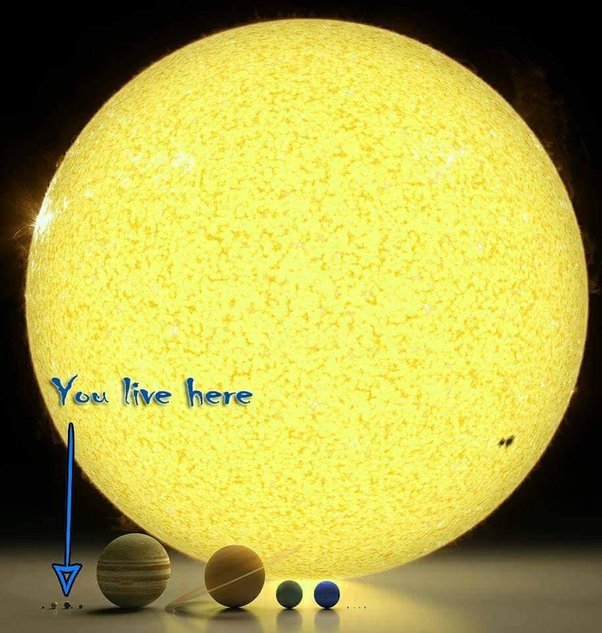 The SUN, Sol, RA to the Egyptians, Our Local Star - classified as a Yellow Dwarf, so not very big in the Universe.
But our Sun is the dominant body in our local Solar System, Earth is a mere speck compared to our Yellow Dwarf STAR. The image, needs to be shown in every school, college and university. In addition it needs to be seen in context of all the Climate Alarmism, so frequently reported in all media, government and educational output.
When it comes to planet Earth, the most important source of light, heat, and energy actually comes from beyond our world. It’s the Sun that is the driver of the Earth’s energy balance, rather than the internal heat given off by the planet itself from sources like gravitational contraction and radioactive decays. The energy from the Sun keeps temperatures from freezing all across the planet, providing us with temperatures that allow liquid water on Earth’s surface, and that are essential to the life processes of nearly every organism extant on our world today.
And yet, it’s only within the last 200 years that humanity has even understood how much energy, overall, the Sun actually produces. Considering all of the scientific advances that came afterward, including the development of stellar, quantum, and nuclear physics, as well as the understanding of the subatomic fusion reactions that power the Sun, it might seem like a trivial matter to simply answer the question of “How much energy does the Sun produce?”
In their book "The Role of the Sun in Climate Change" Douglas V Hoyt and Kenneth H Shatten, argue that the forcing "effects" of volcanic aerosols, anthropogenic aerosols, and greenhouse gas warming - are just theories; {see citation after the "READ MORE" section}
"...and we will treat these theories with skepticism, .......as we do for SOLAR FORCING of climate"
Alberta Changes the CO2 imperative
- Details
- Written by: Gregory Wrightstone
- Category: Climate Science
- Hits: 2364
On November 2, Alberta’s ruling United Conservative Party (UCP) approved a resolution stating, in part:
“CO2 is a nutrient foundational for all life on Earth…The earth needs more CO2 to support life and to increase plant yields, both of which contribute to the Health and Prosperity [sic] of all Albertans.”
A UCP member speaking in favor of the resolution stated:
“According to the CO2 Coalition, higher CO2 levels have led to healthier crops and improved food security worldwide.”
The resolution recommended that the Government of Alberta should:
- Abandon Net Zero targets
- Remove the designation of CO2 as a pollutant
- Recognize that CO2 is a foundational nutrient for all life on Earth
As you can imagine, this did not sit well with the climate alarmist community. DeSmog Blog called us “the notorious CO2 Coalition.” Another stated:
“The CO2 Coalition, an organization that promotes the view of carbon dioxide as beneficial, appears to have influenced Resolution 12. During the UCP’s annual general meeting, a member advocating for the resolution cited the CO2 Coalition, stating that ‘higher CO₂ levels have led to healthier crops and improved food security worldwide.’ This reference suggests that the CO2 Coalition’s materials and messaging contributed to shaping the arguments and rationale behind the UCP’s decision to reclassify CO₂ and abandon net-zero emission targets.”
But wait… there’s more:
“The US-based Coalition must be squirming in their dampened seats in excitement at having the home of the oil sands not just be a hot bed of interest in their antediluvian, a-scientific perspective, but actually changing the official policy of the ruling party. I’m sure that gasoline soaked paper bags were being passed around at what passes for the Coalition’s headquarters, huffing cancer-causing hydrocarbons clearly being their drug of choice.”
This commentary was first published in the CO2 Coalition Newsletter (email subscription available on our homepage).
Gregory Wrightstone is a geologist; executive director of the CO2 Coalition, Arlington, VA; author of Inconvenient Facts: The Science That Al Gore Doesn’t Want You to Know and the soon-to-be-published book, A Very Convenient Warming – How Modest Warming and More CO2 are Benefiting Humanity.
Bio-Methane for CHP
- Details
- Written by: J C Burke
- Category: Biomethane CHP
- Hits: 3074
 Bio-Methane is simply methane generated from organic wastes {in an oxygen starved environment}. Methane capture from coal mines, and methane from other sources {such as tapping into waste-dumps} is a welcome strategy to utilise the enormous amount of waste, we produce. Estimated at 105bn tonnes globally by the World Bio-Gas Association {see article re -methane here on new tab - close to return here}.
However, it is perfectly OK to use methane from oil/gas exploration too - and with the UK's highly extensive gas grid, its all carried together to provide primary energy. Energy that is easily stored. Unlike that secondary energy source - electricity - which we will discuss further later.
But CHP? Combined Heat AND Power {and sometimes cooling}
We have tried to introduce CHP previously, as an important and strategic alternative to Centralised Electricity Generation. There are major disadvantages with centralised generation;
- Inefficiency discussed previously here {click} and again here {click} and cooling towers explained here {click}
- Instability
- Storage Problems
- Supply to Match Demand Problems Nationally
Bio-Methane for CHP Heat Networks
- Details
- Written by: J C Burke
- Category: Biomethane CHP
- Hits: 5172
Bio-Methane is simply methane generated from organic wastes {in an oxygen starved environment}. Methane capture from coal mines, and methane from other sources {such as tapping into waste-dumps} is a welcome strategy to utilise the enormous amount of waste, we produce. Estimated at 105bn tonnes globally by the World Bio-Gas Association {see article re -methane here on new tab - close to return here}.
However, it is perfectly OK to use methane from oil/gas exploration too - and with the UK's highly extensive gas grid, its all carried together to provide primary energy. Energy that is easily stored. Unlike that secondary energy source - electricity - which we will discuss further later.
But CHP? Combined Heat AND Power {and sometimes cooling}
We have tried to introduce CHP previously, as an important and strategic alternative to Centralised Electricity Generation. There are major disadvantages with centralised generation;
- Inefficiency discussed previously here {click} and again here {click} and cooling towers explained here {click}
- Instability
- Storage Problems
- Supply to Match Demand Problems Nationally
Page 6 of 10