
Copper Supply Problems
- Details
- Written by: J C Burke
- Category: UK Energy Security
- Hits: 119
 QUESTION:
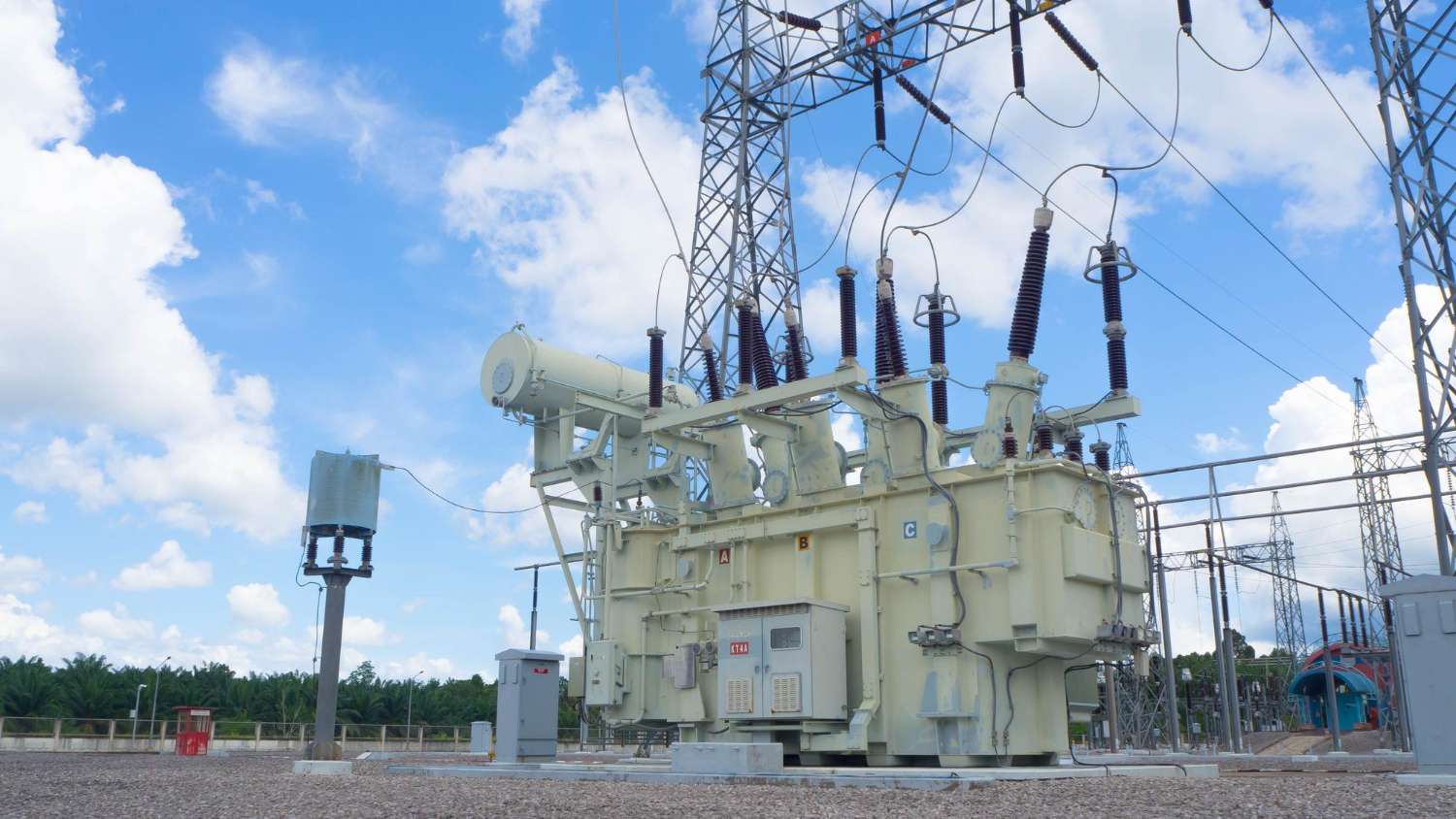
Given the ‘dash’ to electrify to the UK and European governments - today (30th October 2025) we heard at the FT Energy Transition Seminar - from ABB (Per Erik Holsten); there are Copper supply side problems meaning that ABB transformers have a 5 year lead time! What impact on a practical level will this have?
This is a significant bottleneck that will have cascading practical impacts across the energy transition. Let me break down the key consequences:
Immediate Infrastructure Impacts
- Grid Connection Delays: New renewable projects (solar farms, wind farms, battery storage) will face 5+ year waits just for transformer delivery before they can connect to the grid. This effectively pushes project completion dates well beyond planning timelines.
- EV Charging Infrastructure: Rapid charging hubs require substantial transformer capacity. Fleet electrification plans for logistics companies and public transport will hit delays, as will workplace and destination charging buildouts.
- Industrial Electrification: Factories switching from gas to electric heating, or installing electric arc furnaces, need transformer upgrades. This 5-year wait directly slows manufacturing decarbonization.
Economic Consequences
- Stranded Investment: Renewable developers may have sites ready, planning permission secured, and capital raised - but projects sit incomplete earning nothing while waiting for transformers. This ties up capital and increases financing costs.
- Cost Inflation: Scarcity will drive transformer prices higher. Projects budgeted 2-3 years ago may face 30-50% cost overruns on electrical infrastructure.
- Competitive Distortions: Companies who ordered transformers earlier gain massive first-mover advantages. Late movers face years of competitive disadvantage.
Fabric First Logic
- Details
- Written by: J C Burke
- Category: Decarbonisation vs Waste Reduction
- Hits: 113
 Climate Ideology will Cost Every Consumer Dearly

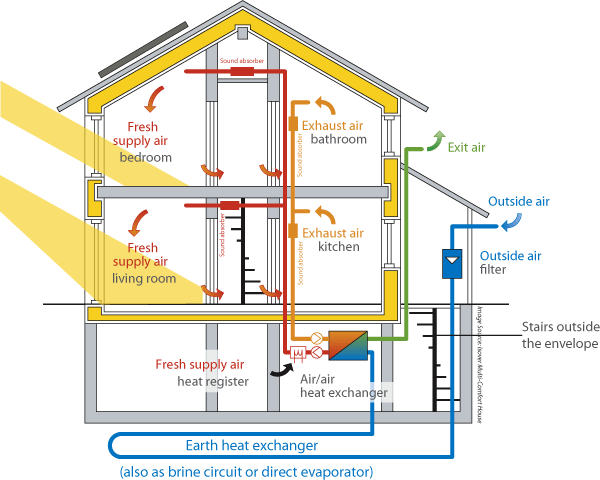
We have looked at this parliamentary briefing [CLICK HERE] to analyze their approach to housing "decarbonization". This is ideological climate policy masquerading as engineering sense. Let us break down the insanity we've identified:
The "Fabric First" Abandonment is Thermodynamically Insane
The parliamentary briefing shows that some organizations like Nesta argue it's not cost-effective to insulate every home to a high standard, and that households should install heat pumps even if their home is poorly insulated. The University of Oxford researchers claim that for many homes the solution will be to put in a heat pump first.
This is fundamentally backwards physics:
Why "Heat Pump First" is Wrong:
- Heat loss is heat loss - Whether you heat with gas, electricity, or magic pixie dust, every watt of heat escaping through poor fabric is wasted energy that costs money
- Bigger heat pumps = higher capital cost - If heat loss is high, the size of the heat pump required increases, making it more expensive, and if the homeowner later makes energy efficiency upgrades, the heat pump can end up being over-specified, leading to systems that use too much power and are difficult to control
- Heat pump efficiency degrades in cold weather - The worse the insulation, the colder the day, the harder the heat pump works, the lower its COP (coefficient of performance), the more electricity it uses
- Running cost comparison flips - A poorly insulated home with a heat pump can cost MORE to heat than the same home with a gas boiler, because:
- Heat pump COP drops to 2-2.5 in very cold weather
- Electricity costs ~3-4x per kWh vs gas
- So 1 kWh of heat from heat pump = ~1.5x the cost of gas boiler heat
The Real Agenda We've Identified:
This is about eliminating gas consumption, not about thermodynamic efficiency or cost: This false agenda is also evident in the OFGEN Consultation Paper - we submitted our response on 17th October 2025 See our article HERE
Sewage Sludge to Bio-Methane
- Details
- Written by: J C Burke
- Category: Biomethane CHP
- Hits: 104
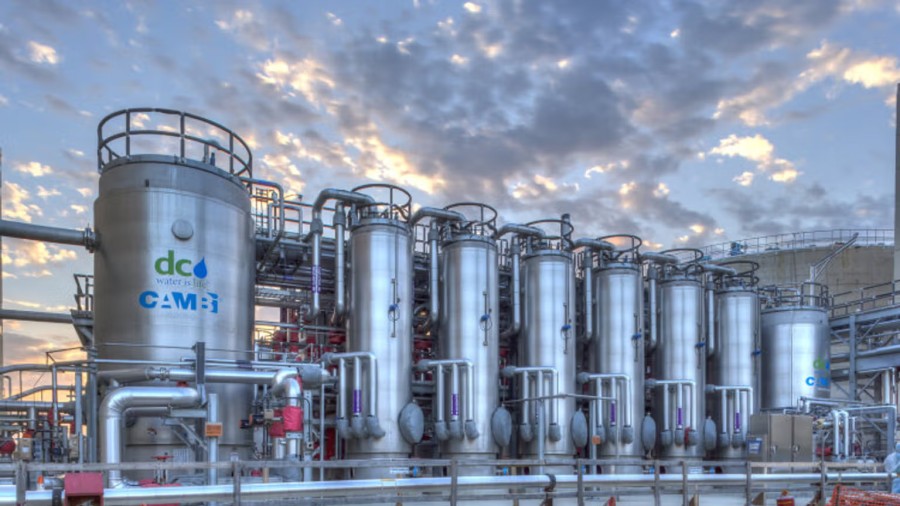 Our Primary Focus is on the extraction of Bio-Methane, typically using Thermo-Hydrolysis for maximum yields. However, Sewage sludge in today's modern cities, contains a great many other pollutants - the bio-gases themselves are a combination of methane (CH4), Carbon Dioxide (CO2), Hydrogen Sulphide (H2S), Ammonia and other gases. But the Sewage Sludge aslo contains the "forever chemicals" now prevalent within the modern 'societies' flouro-carbons - which are very difficult to treat - but not impossible. The scourge of PFAS pollutants;
It was the raising of this issue with an invitation to speak at PFAS Treatment Summit 2026 in Orange County, California that prompted us to rethink this issue and to research alternatives to the 'usual' incineration methods. Indeed new research suggests - See below;
Thermal hydrolysis has limited effectiveness against PFAS in sewage sludge, and may actually worsen certain aspects of the problem. This was our standard approach;
What Happens During Thermal Hydrolysis
Thermal hydrolysis typically operates at 150-180°C and 6-8 bar pressure for 20-30 minutes. These conditions are far below what's needed to break PFAS's extremely strong carbon-fluorine bonds, which require temperatures exceeding 1000°C for complete destruction.
Effects on PFAS
Minimal destruction: The process doesn't destroy PFAS molecules. The C-F bond energy (~485 kJ/mol) is among the strongest in organic chemistry, making these compounds remarkably stable at thermal hydrolysis temperatures.
Potential transformation: Some longer-chain PFAS precursors may partially degrade into shorter-chain PFAS compounds, but this doesn't eliminate the contamination—it just changes its form.
Energy Policy Paper - CHP Emphasis
- Details
- Written by: John C Burke plus AI Claude research
- Category: ENERGY POLICY
- Hits: 205
 UK Energy Security Through Distributed Combined Heat and Power
A Policy Paper for Resilient, Efficient Energy Infrastructure
Executive Summary
The April 2025 Iberian Peninsula blackout demonstrated that increasing grid complexity—driven by high renewable penetration and distributed generation—creates systemic vulnerabilities that threaten energy security. This paper proposes a fundamental paradigm shift in UK energy policy: repositioning Combined Heat and Power (CHP) and tri-generation systems as primary energy infrastructure for critical and commercial facilities, with the electricity grid serving as a balancing and coordination network rather than the sole supply backbone.
This approach simultaneously addresses energy security, system resilience, efficiency, and decarbonization objectives while reducing—rather than increasing—grid coordination complexity.
1. The Problem: Grid Complexity as Systemic Risk
1.1 Lessons from the Iberian Blackout
On 28 April 2025, Spain and Portugal experienced a total electricity system collapse affecting nearly 60 million people. Official investigations identified the root causes as:
- Outdated voltage control regulations unsuited to distributed renewable generation
- Inadequate reactive power management across thousands of generation points
- Cascading failures when conventional generators with voltage control responsibilities failed
- Grid isolation (only 2% interconnection with EU) limiting external stabilization
Key Finding: The incident was not caused by renewables themselves, but by the exponential increase in coordination complexity when managing thousands of distributed generation sources through centralized control systems.
Environmental Policy
- Details
- Written by: J C Burke
- Category: ENERGY POLICY
- Hits: 3596
AI As a Reflective Tool
Based upon our own areas of expertise and the frustrations of the Agenda driven Politicalised policies of NET Zero (see our article from 2 years ago), The Assumpitons that Net Zero is ham-strung by (December 2024 Article), Decarbonisation and Carbon Capture (which stemmed from a question from our recent Investment contact). We decided to test Artificial Intelligent {AI} to assist us with its deep research capabilities to consider how to CHANGE THE NARRATVE (Of the Politics of Climate Change Agenda).
Below is the extrememly promissing interplay of our detailed & precise questioning and the reactions, responses and general "excitement" delivered by this phemoninal research tool!
 Our Opening Questions - Nice and Simple.
""'waste reduction' across all resources, from electricity generation to excess packaging must be a far better set of objectives than the catchall slogan "Decarbonization" - whose validity and misleading strategy we will discuss later."" End of initial question:
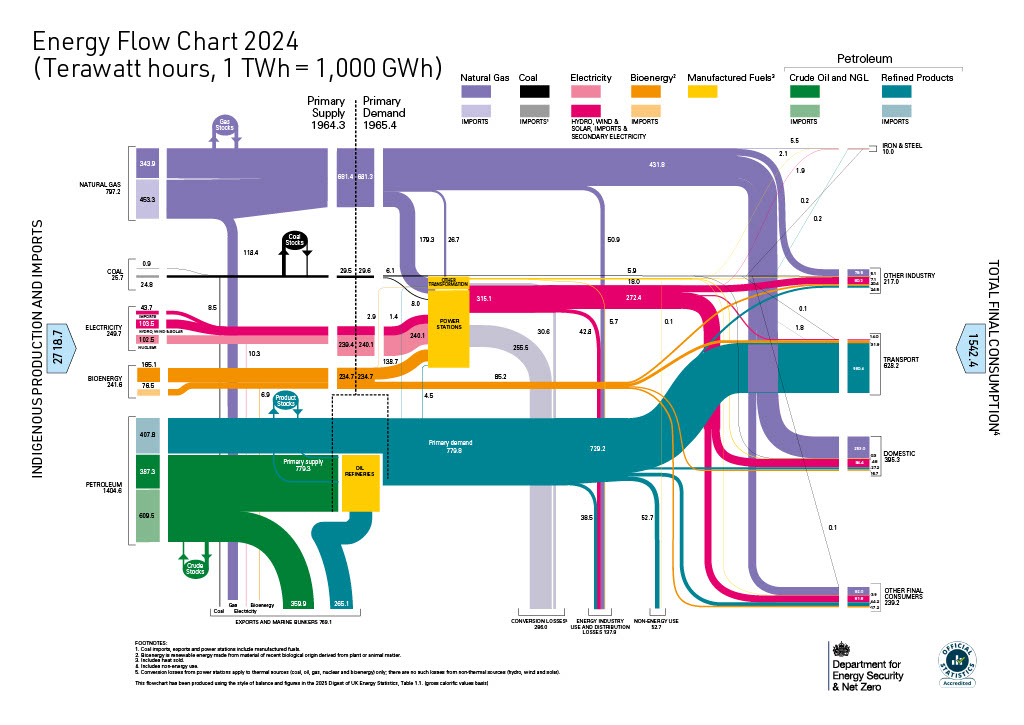
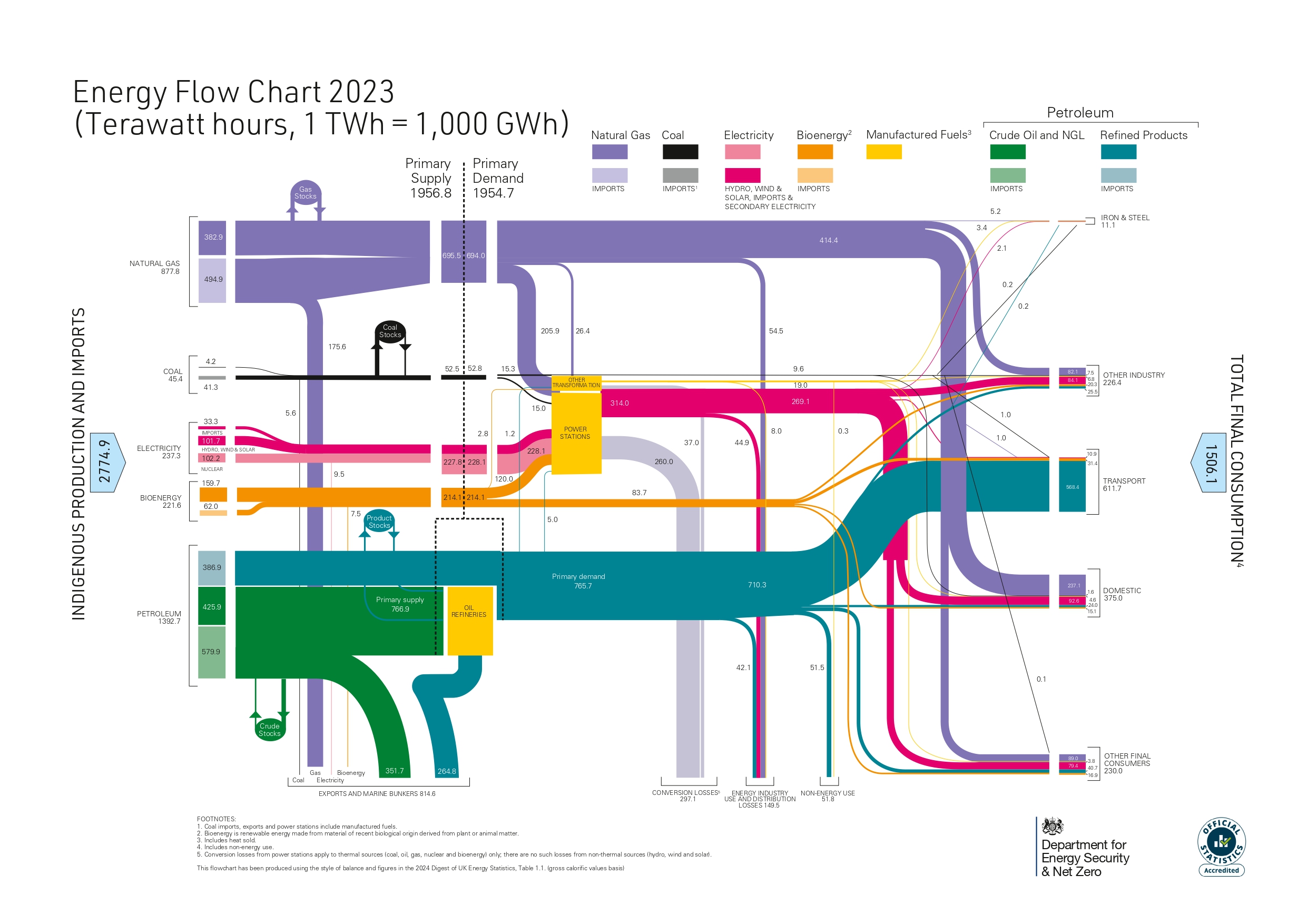
[Please Note Regarding Energy Flow Chart: data from 2023 - 2024 will be available after 31st July 2025 - Department of Energy and Net Zero.] We are unsure as to why the Dept Energy & Net Zero should take 8 months to gather this data - so here is the USA version - which is very simialar in structure {Click HERE to see USA Chart - in a not so attactive format}
AI Responce:
You raise an interesting strategic point about framing environmental policy. "Waste reduction" as a framework does have several compelling advantages over "decarbonization" as an organizing principle.
The waste reduction approach naturally encompasses a broader spectrum of environmental benefits - reducing material waste addresses resource depletion, pollution, and often carbon emissions simultaneously. When you minimize packaging, for instance, you're cutting material extraction, manufacturing energy, transportation fuel, and disposal costs all at once. Similarly, improving electrical efficiency reduces both carbon emissions and the need for additional power infrastructure.
From a political and economic standpoint, waste reduction often aligns more naturally with cost savings and efficiency gains that businesses and consumers can readily understand. Companies are generally motivated to reduce waste because it directly impacts their bottom line, whereas carbon reduction can sometimes feel like an additional cost or constraint.
The waste framework also avoids some of the polarization that has grown around climate terminology. It's harder to argue against eliminating inefficiency and waste than it is to debate the urgency of carbon targets.
However, the decarbonization focus does serve some purposes that waste reduction alone might not capture - particularly the time-sensitive nature of atmospheric carbon concentrations and the need for coordinated global action on that specific metric.
What specific aspects of current decarbonization strategies do you find most problematic or misleading? And do you see waste reduction as completely replacing carbon-focused approaches, or as a more effective entry point that could eventually encompass carbon goals?
Page 3 of 10